The scenario is familiar to anyone who has tried to start a car in the cold: you turn the key, the starter makes a couple of weak attempts — and then silence. The battery dies at the worst possible moment, the nearest service is far away, and there is no one around to give you a jump. A dedicated jump starter solves that one situation, but it is only one of many roadside problems. A flat tyre, a dead phone running your navigation, hunting for a valve in the dark — each task usually means its own separate device in the boot.
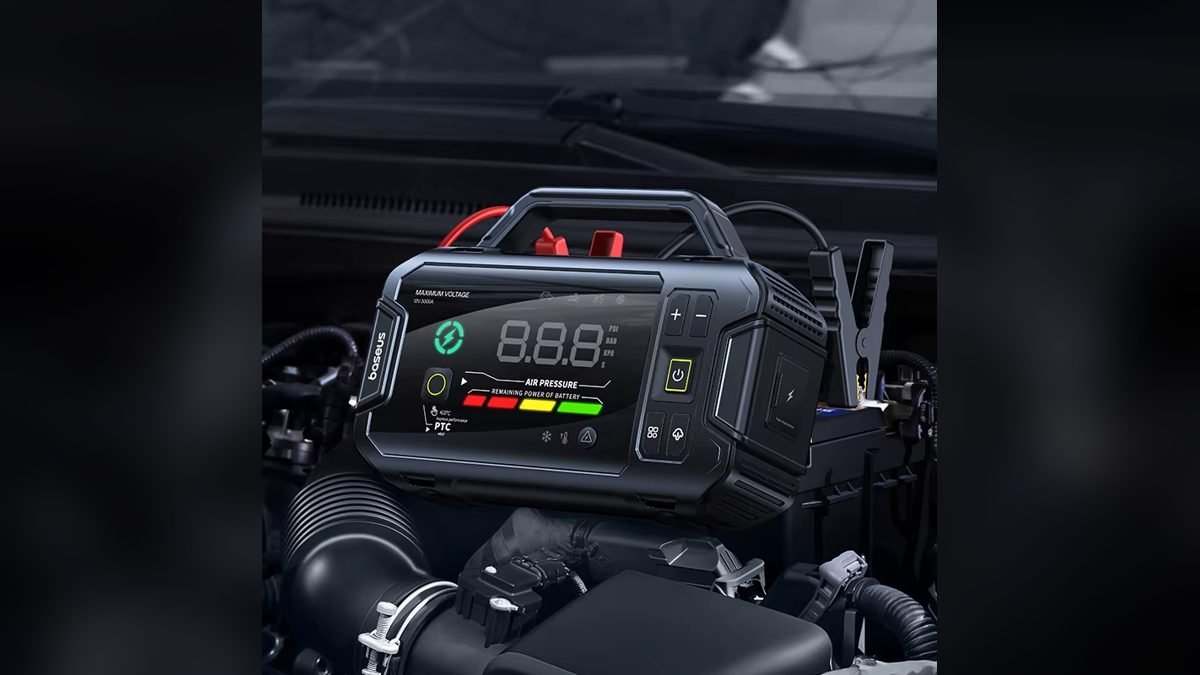
The Baseus Prime Trip VJ1 takes a different route: instead of four separate gadgets, you get a single unit that can start the engine, inflate tyres, charge devices and work as a flashlight. The rated peak current is 3000 A, which is more than enough for passenger cars and most SUVs. The idea itself is not unique to the market, but this particular model packages all four functions neatly and in a relatively compact body.
Below is a breakdown of each function separately: what the VJ1 actually covers, where its honest limits are, how it differs from pure jump starters, and who really needs this kind of all-in-one tool — and who would be fine with something simpler.
What “4-in-1” means and why combine functions
The “4-in-1” formula means a single device packs a jump starter, an air compressor, a power bank and an LED flashlight. As separate items, that is four gadgets with four chargers, four spots in the boot and four ways to forget to charge something. The VJ1 reduces them to one block with a shared battery and a single recharge point over USB-C.
The practical benefit here is not marketing but readiness. A device that sits charged and always within reach saves you on the road far more often than a powerful but bulky kit scattered across different bags. That is exactly why such units are popular with car dealers and used-car buyers: on a lot with dozens of vehicles, something constantly needs starting, inflating or lighting, and dragging a wheeled booster around for that is impractical.
The flip side of any all-in-one is compromise. A universal device almost always loses to a specialised one in one or two parameters: the compressor is slower than a stationary one, the flashlight is no match for a proper work light. But for roadside tasks that is usually enough — and the compactness and self-sufficiency outweigh it.
Jump starter: 3000 A and cold-weather starts
The main job of the VJ1 is starting the engine when the battery is flat. The rated 3000 A peak current at 12 V is designed for large-displacement petrol engines and diesels. For an ordinary sedan it is even excessive, but a current reserve is exactly what you need in the cold: in frost the oil thickens, the load on the starter rises, and a weak device may fail where a powerful one will not.
The operating temperature range runs from −20 to +60 °C. For confident cold starts the model has a low-temperature pre-heating function (PTC): in sub-zero weather the device first warms the cells so it can deliver the correct current. This is an important detail — it is precisely at near-zero and negative temperatures that cheap jump starters most often give up.
Connection runs through smart clamps with built-in protection. In practice that gives you:
- Reverse-polarity protection — if you swap the terminals, the device will not deliver current and will not damage the electronics.
- Short-circuit and reverse-charge protection — reduces the risk of sparking and damage to the unit itself.
- Charge-level monitoring — the display shows the remaining charge, and to start a fully dead battery the maker recommends keeping the unit’s own charge above a certain threshold.
An honest caveat: 3000 A is a peak, not a continuous value. The real starting current is lower, and that is normal for the whole class. For the vast majority of passenger-car tasks the VJ1 has plenty of headroom; limits only appear on large commercial vehicles, for which dedicated heavy-duty boosters exist.
Air compressor: 0–150 PSI with auto-stop
The built-in pump is the second most useful function and the thing that sets the VJ1 apart from pure jump starters. The pressure range is 0 to 150 PSI with digital control: you set the target value and the compressor stops on its own once it is reached. The kit includes a hose around 24 inches (≈60 cm) long and three nozzles, so reaching the valve and switching to inflatable gear is convenient. It is clearer than manual pumps, where pressure has to be checked by eye with a separate gauge.
The use cases are broader than they seem. Beyond topping up tyres on the shoulder, the compressor comes in handy for:
- topping off a slightly low tyre before a long motorway stretch;
- air mattresses, swim rings and boats during waterside trips;
- bicycle and children’s wheels, sports equipment.
Where the limits are: the built-in compressor will not replace a stationary garage one — it is meant for roadside volumes, not for daily work with heavy rubber. It can inflate a tyre from flat, but that takes noticeable time, and long continuous cycles should be avoided to keep the pump from overheating. For emergency top-ups and household tasks its output is enough.
Power bank: capacity and charging
Inside the unit is a 21,600 mAh battery (four 5400 mAh cells, 14.8 V / 79.92 Wh), which makes the VJ1 a full-fledged power bank. Usable output over USB at 5 V is about 12,500 mAh: that is the normal class difference between cell capacity and the real output after voltage conversion. A dead phone on the road is no smaller a problem than a flat battery: without navigation and a connection, even a minor breakdown turns into trouble. Here the capacity is enough to top up a smartphone several times or feed a tablet.
Charging runs over USB-C and USB-A: the input for recharging the unit itself is 5 V/3 A, 9 V/2 A, while the output to gadgets is up to 18 W per port (9 V/2 A or 12 V/1.5 A). That is an honest power-bank level for smartphones, tablets and small electronics — the device is not built to charge a 65–100 W laptop, and that is fine for an emergency automotive tool. A single USB-C cable ecosystem covers both refilling the unit and charging your phone, so there is no need to carry a separate set of cables.
Worth noting separately is the low standby consumption: the device holds its charge for a long time sitting in the boot. That is critical for an emergency tool — it has to fire when needed, not turn out to be flat “together” with the car. Even so, the general rule for all jump starters still applies: check the remaining charge before long trips and in winter.
Flashlight: light when everything else fails
The fourth function is a built-in LED flashlight with a stated brightness of around 500 lumens. Against the starting power it seems a trifle, but it is the flashlight that most often saves the day in everyday situations: finding a valve in the dark, inspecting a tyre on the shoulder, lighting the path to a tent or the bonnet during an evening repair.
The model has several light modes:
- Steady light — for illuminating the work area during a repair or in a car park.
- Strobe — draws attention, useful for marking yourself on the road.
- SOS — an emergency Morse-code signal for critical situations.
A full headlamp or handheld work light it will not replace, but as an emergency source of light it logically rounds out the set: the device covers the dark with the same button that starts the engine and inflates the tyre.
Build, display and Prime Trip reliability
The VJ1 belongs to the Prime Trip series, which Baseus positions as “travel-grade” — built for real use rather than the shelf. The body is made of fire-retardant ABS+PC plastic, with an informative digital display on the front showing charge level, pressure and port status. Dimensions of roughly 268×186×94 mm (model C01199) set the tone right away: this is not a pocket booster for the glovebox but a full-size block that lives in the boot — but for that size you get a built-in compressor and a serious current reserve.
In the hand the device feels solid: the ports are well thought out, nothing rattles, and there is no sense of a disposable toy. This is a typical Baseus strength in the mid segment — the brand keeps its reputation not through exotic specs but by getting the basics done properly.
If you are generally picking out gadgets for the cabin, there is a neighbouring CarlinKit CarPlay adapter review on this blog — a different class of device, but built on the same logic of making a trip more convenient without touching the wiring.
Want to buy the Baseus Prime Trip VJ1?
Price and availability — on AliExpress
This is an affiliate link. The price stays the same for you — we earn a small commission that supports Findugo.
Comparison: all-in-one vs separate devices
The main alternative to the VJ1 is not a specific model but the approach itself: buying a separate jump starter, a separate compressor, a separate power bank and a flashlight. Such a set will almost always win on each individual parameter: a specialised compressor is faster, a separate power bank holds more, a work light is brighter. It loses elsewhere — in readiness and weight.
- Separate devices: higher peak figures for each function, but four units, four chargers, more space and a greater chance that, at the crucial moment, something turns out to be flat or left at home.
- VJ1 (4-in-1): one charged block for all the basic roadside tasks, a single USB-C charge, compactness. The price is compromises on the “ceiling” of each function.
Within the Baseus line-up there are narrower models too: the Super Energy series, for example, with the same 3000 A peak current and a larger battery but no built-in compressor — that is a “jump starter + power bank” combo. The VJ1 stands out precisely by adding the pump, and if inflating tyres is a real rather than hypothetical scenario for you, that argument outweighs the rest.
You can check the current price, package contents and exact specifications on the product page on AliExpress — parameters can vary slightly between revisions and sellers.
Who it’s for, and who can do with less
The VJ1 makes sense if at least one of these profiles fits you:
- Long-haul trips and motorways: when service may be tens of kilometres away and help is out of reach.
- Winter use: the current reserve and PTC pre-heating noticeably raise the odds of a confident start in frost.
- Outdoor and camping: a compressor for mattresses and boats, a power bank for phones, a flashlight for the campsite — all in one body.
- Automotive professionals: dealers and used-car buyers who need a mobile “start / inflate / light up” solution right on the lot.
When the purchase is excessive: if you only drive around town, service and a tow truck are always nearby, and you inflate tyres at the petrol station, the whole potential of the “4-in-1” will go unused. In that case it makes more sense to take a compact power-bank booster without a compressor — it is cheaper and lighter.
What to check and set up after unboxing
To make sure the device is ready exactly when you need it, run through a few steps after it arrives:
- Check the package contents against the manual: the unit itself, smart clamps, the USB-C cable, the hose and compressor nozzles.
- Fully charge the device before first use — this applies both to a new unit and to one that has sat for a long time.
- Study the display: how charge level, pressure and port status are shown.
- Learn the flashlight modes (steady / strobe / SOS) in advance, not in the dark on the shoulder.
- Practise connecting the clamps: on a correct connection the indicator confirms readiness to start.
- Remember the charge rule: to start a fully dead battery, keep the unit’s own energy above the recommended threshold.
- In frost, let the device run its pre-heating before attempting a start.
- Store the unit charged and check the remaining level periodically — especially before long trips and in winter.
FAQ
Will the VJ1 start a diesel or a large SUV?
The 3000 A peak current is designed for large-displacement petrol engines and diesels. For passenger cars and most SUVs the current reserve is sufficient. Limits begin on heavy commercial vehicles, which use dedicated high-power boosters.
Is this a battery or a supercapacitor device?
The VJ1 is battery-based, meaning it stores energy in rechargeable cells. Supercapacitor jump starters are a separate class with different use cases. The usual rule applies to the VJ1: keep it charged, especially in winter.
Can the compressor inflate tyres from flat?
Yes, but it takes noticeable time — the built-in pump is meant for roadside top-ups and household tasks, not for daily work. For an emergency inflation on the shoulder its capability is enough; for constant work with heavy rubber a stationary compressor is better.
How many times can it charge a phone?
The battery capacity is 21,600 mAh, with usable output over USB of about 12,500 mAh at 5 V, which is enough for several full smartphone charges (the exact number depends on your phone’s capacity). Charging runs over USB-C and USB-A with up to 18 W per port.
How long does the device hold a charge unused?
The maker cites low standby consumption, so the unit stays ready for a long time sitting in the boot. That does not cancel out checking the charge periodically before trips.
Verdict
The Baseus Prime Trip VJ1 is not a purchase for one function but insurance against a whole set of roadside nuisances that seem trivial on their own yet ruin a trip together. A 3000 A jump starter with cold-weather pre-heating, a compressor with auto-stop, a roomy USB power bank and an emergency flashlight are gathered into one compact body with an honest reserve of reliability.
The honest limits are clear too: each individual function yields to a specialised device, and the compressor does not like long cycles. But precisely as a universal emergency solution that is always charged and always at hand, the VJ1 does its job — and for those who drive a lot out of town or in winter, it pays for itself on the very first genuinely bad day.
💡 This review contains affiliate links. If you click through and make a purchase, we may earn a commission at no extra cost to you. This supports our editorial work and does not affect our recommendations. Learn more →