A portable mini vacuum cleaner stopped being a toy a while ago: brushless motors and dense filtration have packed power once reserved for full-size machines into a body the size of a thermos. The question for buyers is no longer “should I get one” but “which of the near-identical models to pick” — because the shelf holds two visually similar devices built on completely different engineering logic.
We took two popular models in the same class — the Mi Vacuum Cleaner Mini (Xiaomi/Mijia, SSXCQ01XY) and the Baseus A2 Pro (VCAQ040001). Both charge over Type-C, both use a washable HEPA, both target cars and spot home cleaning. From there the differences begin: pressure versus rpm, a small battery versus a triple one, pure suction versus a blow function.
Below is a fact-based comparison without the marketing: a summary table, a breakdown of suction (why 13,000 Pa and 50,000 rpm cannot be compared head-on), battery and runtime, filtration, nozzles, size and noise. At the end — a direct verdict on who each model suits. For the Xiaomi unit on its own, see the full Mi Vacuum Cleaner Mini review.
Each one in brief
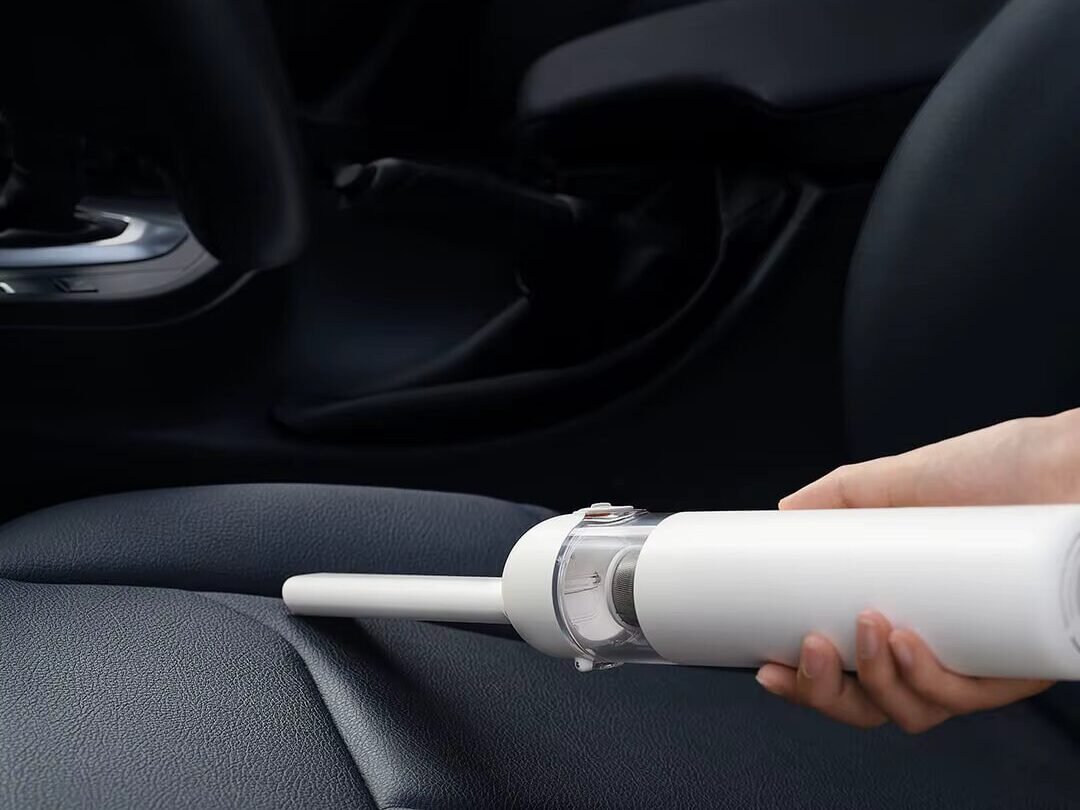
The Mi Vacuum Cleaner Mini bets on a sealed air path and high static pressure. A brushless motor, straight dual-vent design, peak suction up to 13,000 Pa in strong mode, two-stage “steel + HEPA” filtration. Light (≈0.5 kg) and built into the Mijia ecosystem.
The Baseus A2 Pro bets on air volume and runtime. A 50,000 rpm motor, airflow up to 500 L/min (80 AW), a triple 6,000 mAh battery (3×2000), plus a bonus blow function: the blower nozzle turns the device into a mini air blower for keyboards and vents.
Summary comparison table
| Parameter | Mi Vacuum Cleaner Mini | Baseus A2 Pro |
|---|---|---|
| Model | SSXCQ01XY | VCAQ040001 |
| Suction (Pa) | 7,760 (std) / 13,000 (strong) | 6,000 (marketed up to 7,000) |
| Motor | brushless, ~13,000 rpm | 50,000 rpm |
| Airflow | not stated | up to 500 L/min (80 AW) |
| Battery | 2,000 mAh (10.8 V) | 6,000 mAh (3×2000) |
| Runtime | up to 30 min / 9 min (strong) | ~25 min, up to 20 cleans per charge |
| Charging | Type-C, 5V/2A (adapter separate) | Type-C, 5V/2A, ~3.5 h |
| Filter | steel + HEPA, washable | HEPA 99.7%, washable |
| Blow function | no | yes (blower nozzle) |
| Weight | ~0.5 kg | ~508 g |
| Noise | not stated by maker | <65 dB |
| Dust bin | compact | 120 ml |
Suction and motor: why 13,000 Pa ≠ 50,000 rpm
This is the main trap when choosing. Makers deliberately put different metrics on the box, and you cannot compare them head-on.
- Pascals (Pa) — static pressure. It governs the ability to lift stuck, fine and ground-in dirt from gaps and textiles. Xiaomi has the edge here: 13,000 Pa versus 6,000 Pa.
- RPM and airflow (L/min) — about the volume of air moved. Baseus’s high 50,000 rpm and 500 L/min handle large debris and big areas better in a single pass.
The practical takeaway is simple. If the task is digging fine dust out of a keyboard, seat seams and gaps, pressure matters more, and Xiaomi is stronger. If the task is quickly collecting crumbs, sand and hair across a large area, airflow matters more, and the argument goes to Baseus. One is “more powerful” than the other only in a specific scenario, not in general.
Battery and runtime
Here the picture mirrors. Xiaomi has a single 2,000 mAh cell: up to 30 minutes in standard mode, but only 9 minutes in strong — the high peak discharge current is paid for in time. Baseus uses a triple 6,000 mAh pack (3×2000): around 25 minutes of continuous work and up to 20 cleans on one charge, but a full charge takes about 3.5 hours.
In short: Xiaomi wins on duration in the gentle mode, Baseus on total reserve between charges. Neither runs while charging, and both use a 5V/2A adapter.
Filtration and maintenance
The principle is similar on both: a washable HEPA filter that must not be soaked and must be fully dried before reinstalling. The difference is in the details:
- Xiaomi — two-stage: a steel mesh cuts off large fractions, HEPA traps the fine stuff. Rinse all elements under water, dry 24 hours, full HEPA replacement every 3 months, up to 50 cycles.
- Baseus — HEPA traps up to 99.7% of particles; the maker advises cleaning the filter every 5–6 uses and likewise drying it fully before reinstalling.
Xiaomi has a useful diagnostic touch: if the indicator blinks red and white alternately and the device shuts off after a minute, it is not a dead battery but the blocking protection — a clogged HEPA. Rinsing and drying restore suction.
Nozzles: where Baseus has the trump card
Xiaomi has three suction-only nozzles: crevice (narrow gaps, interior corners), brush (keyboards, curtains, delicate furniture) and combined (for deep cleaning under seats).
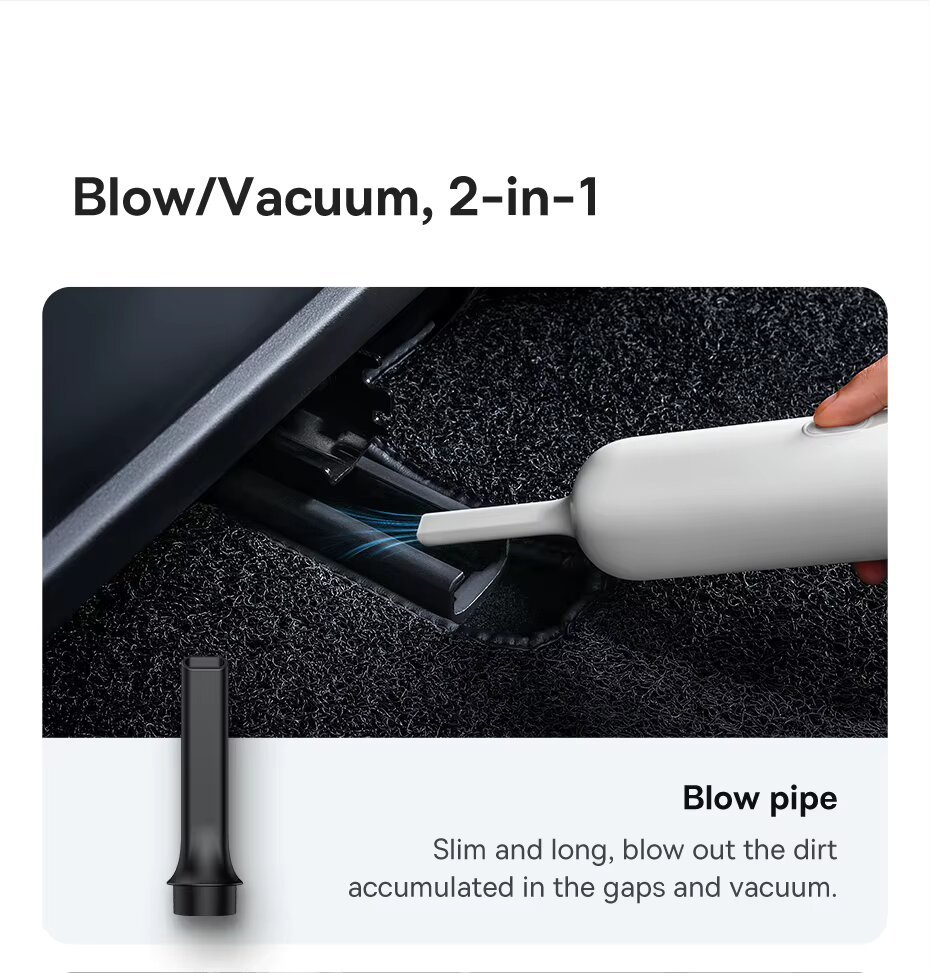
Baseus‘s key difference is the “2-in-1” function: besides suction, there is a separate blower nozzle that works on blow-out. It can blow dust out of keyboards, vents and tight gaps that suction cannot reach. The base set also includes a brush and a crevice nozzle. For anyone cleaning electronics and ventilation, blow-out is a real advantage Xiaomi lacks.
Construction and noise
The approach to the air path differs. Xiaomi bets on sealing: an ABS dust shield and a soft rubber gasket stop air from bypassing the filter, preserving useful pressure, while straight dual ventilation reduces aerodynamic losses. Baseus, in its fight for quiet, uses an optimized airflow buffer and a soundproof board that filters motor noise — hence the stated under 65 dB. Xiaomi does not officially rate its noise level, so a direct decibel comparison is not possible; we only know Baseus puts a specific emphasis on quiet.
Protections and reliability
Xiaomi’s documented protection systems are described in more detail. NTC thermistors monitor temperature and block operation outside 0–40 °C (after overheating it needs 5–10 minutes to cool); there is auto shut-off when the intake is blocked and motor overload protection. The friction sound on shutdown is the normal work of the flap braking system, not a defect. Both models are forbidden for wet cleaning, picking up smouldering ash, and being left in a sweltering car under the sun — lithium cells dislike that.
Price and contents
Both models sit in AliExpress’s affordable segment, and the final price depends on the seller, version and promotions, so check the current listing. By contents, the logic is this: Baseus tends to win on quantity — a triple battery and a blower nozzle in the set, while Xiaomi wins on brand, minimalism and predictable build quality in the Mijia ecosystem. Before buying, check the stated suction on the specific listing (Baseus shows both 6,000 and 7,000 Pa) and the included nozzles.
What is better for specific tasks
- Cleaning electronics, keyboards, fine dust in gaps — Xiaomi (higher pressure) or Baseus with blow-out.
- Car interiors, large debris, sand, hair over a big area — Baseus (higher airflow + bigger battery reserve).
- Minimalism on the desk, Mijia ecosystem, easy upkeep — Xiaomi.
- Charging less often, blowing and vacuuming with one device — Baseus.
If these two are not enough
Both are solid mid-range, but the category is wider. If maximum suction is the priority at any cost, Baseus itself has versions with a stated 12,000–16,000 Pa (the A3 Lite and A5 lines), where pressure is higher at the cost of more power draw and size. That is a different trade-off: more power means more bulk and battery drain. For most household tasks — desk, keyboard, car interior — the Mi Vacuum Cleaner Mini and Baseus A2 Pro pair is enough, and chasing record pascals only makes sense for specific heavy cleaning.
A short note on the data. Xiaomi’s specs come from the model’s technical documentation; for the Baseus A2 Pro they come from the official manual and seller listings. Some figures are presented differently by the makers (Baseus suction is listed as either 6,000 or 7,000 Pa, and Xiaomi’s value depends on the regional version), so the table relies on official numbers and flags marketing ones separately. We did not run a side-by-side lab test — the assessment is built on stated specs and engineering logic, not a field test.
Where to buy
Current prices and availability on AliExpress
Mi Vacuum Cleaner Mini → Baseus A2 Pro →
These are affiliate links. The price stays the same for you — we earn a small commission that supports Findugo.
Verdict: which for whom
Get the Mi Vacuum Cleaner Mini if the priority is maximum pressure for ground-in fine dust, a minimalist design on display and the Xiaomi ecosystem. It is a “grab it and clean the desk, keyboard, seat seams” tool, where suction strength matters more than air volume.
Get the Baseus A2 Pro if runtime reserve (the triple battery) matters more, along with the ability to quickly collect large debris over a big area and the blow function for electronics and vents. It is a more versatile “vac-and-blow”, tuned for the car.
The shared compromises are the same for both: these are secondary vacuums for spot dry cleaning, not a replacement for a full-size one, and a 5V/2A adapter usually is not in the box — budget for it.
FAQ
Which vacuum is more powerful — Xiaomi or Baseus?
It depends on the metric. By static pressure Xiaomi is stronger (13,000 Pa versus 6,000 Pa) — better for fine ground-in dust. By airflow and rpm Baseus is stronger — better for large debris over a big area.
Which model has longer battery life?
Baseus has the larger total reserve (6,000 mAh, up to 20 cleans). Xiaomi gives up to 30 minutes in standard mode, but only 9 minutes at maximum.
Can either of them blow air?
Yes, the Baseus A2 Pro: it has a blower nozzle for blowing dust out of keyboards and vents. Xiaomi has no such function — suction only.
Is a charging adapter included?
Usually not — both charge via a Type-C cable, but you need your own 5V/2A adapter. An incompatible adapter makes Xiaomi blink red rapidly.
Can the filters be washed?
Yes, both have a washable HEPA. It must not be soaked, and the filter is dried before reinstalling. Xiaomi recommends full HEPA replacement every 3 months.
Bottom line
The Mi Vacuum Cleaner Mini and Baseus A2 Pro solve one task by different means. Xiaomi is about pressure, minimalism and dry spot cleanliness; Baseus is about air volume, runtime and versatility with blow-out. There is no “best overall” here — only the best for your scenario.
If the main zone is the desk, electronics and fine dust, Xiaomi is the logical pick. If it is primarily the car, large debris and a wish to charge less often, Baseus is closer. Both remain helpers, not the only vacuum in the house.