Air fryer vs grill is a choice that turns on vocabulary rather than specifications. Two words cover at least three different appliances, and a shopper who has read a few reviews often brings home something other than what they pictured.
The short answer. If you want a crust and bar marks on meat within ten minutes, buy a contact electric grill. If you want one appliance instead of an oven, a dehydrator and a deep fryer, buy an air fryer. These are not two versions of the same machine, and the difference shows up in every dish you cook.
What follows is the mechanics of both, the cost of a single dinner calculated against Czech electricity tariffs, price brackets in EUR and Kč taken from Czech retail in September 2026, and a breakdown of the marketing phrases that carry no information. Outdoor grills, whether charcoal, gas or electric, are outside the scope of this guide.
The naming confusion: what you actually get
Three appliances, two words
British English has a built-in trap here. To grill something traditionally means to cook it under the top element of an oven. The appliance sold in shops as an electric grill does the opposite: it cooks by contact with a hot plate, usually from both sides at once. Same word, different physics.
Air fryer is a worse offender. Nothing is fried in it. The device is a small convection oven with a fan running far faster than an oven fan, in a chamber several times smaller. The name describes the result, not the method.
Then there is the halogen oven, sold from the early 2000s onwards: a glass bowl of 7 to 17 litres with a lid holding the element and the fan. Older articles and many non-English guides describe this appliance while illustrating the text with a basket air fryer. The two behave differently, and the cooking times quoted in those articles belong to the bowl.
What is actually on European shelves
In Czech retail the category is listed as horkovzdušné fritovací hrnce or multifunkční horkovzdušné fritézy. What sits there is single-basket units of 4 to 7 litres and twin-basket units of 10 to 11 litres with a synchronisation function, so that a main course and a side finish together. Glass bowls are absent from these listings.
Contact grills sit in a separate category, kontaktní grily. Open single-surface units, closer to a tabletop barbecue, are listed as elektrické grily.
Practical consequence: searching a Czech or German catalogue for “air fryer” works, searching for “halogen oven” mostly does not. If you specifically want the glass bowl, you are looking at a shrinking market and mainly at resellers.
Identifier: how to tell them apart
The three appliances most often confused with one another.
| Appliance | What it looks like | Working volume | What it does best | Sold in the EU |
|---|---|---|---|---|
| Contact grill | Two hinged plates, food clamped between them | Plate 23×15 to 38×35 cm | Steak, panini, thin cuts | Yes, kontaktní grily |
| Air fryer | Solid casing, pull-out basket or two | 3 to 11 l | Potatoes, chicken pieces, frozen food | Yes, horkovzdušné fritézy |
| Halogen oven | Clear glass bowl, lid with fan | 7 to 17 l | Larger joints, drying, sterilising jars | Rarely, a few listings |
From here on, air fryer means the basket unit, the one you will actually buy. The glass bowl is mentioned separately where the difference matters.
Electric grill: contact cooking
Why the bar marks appear and what they mean
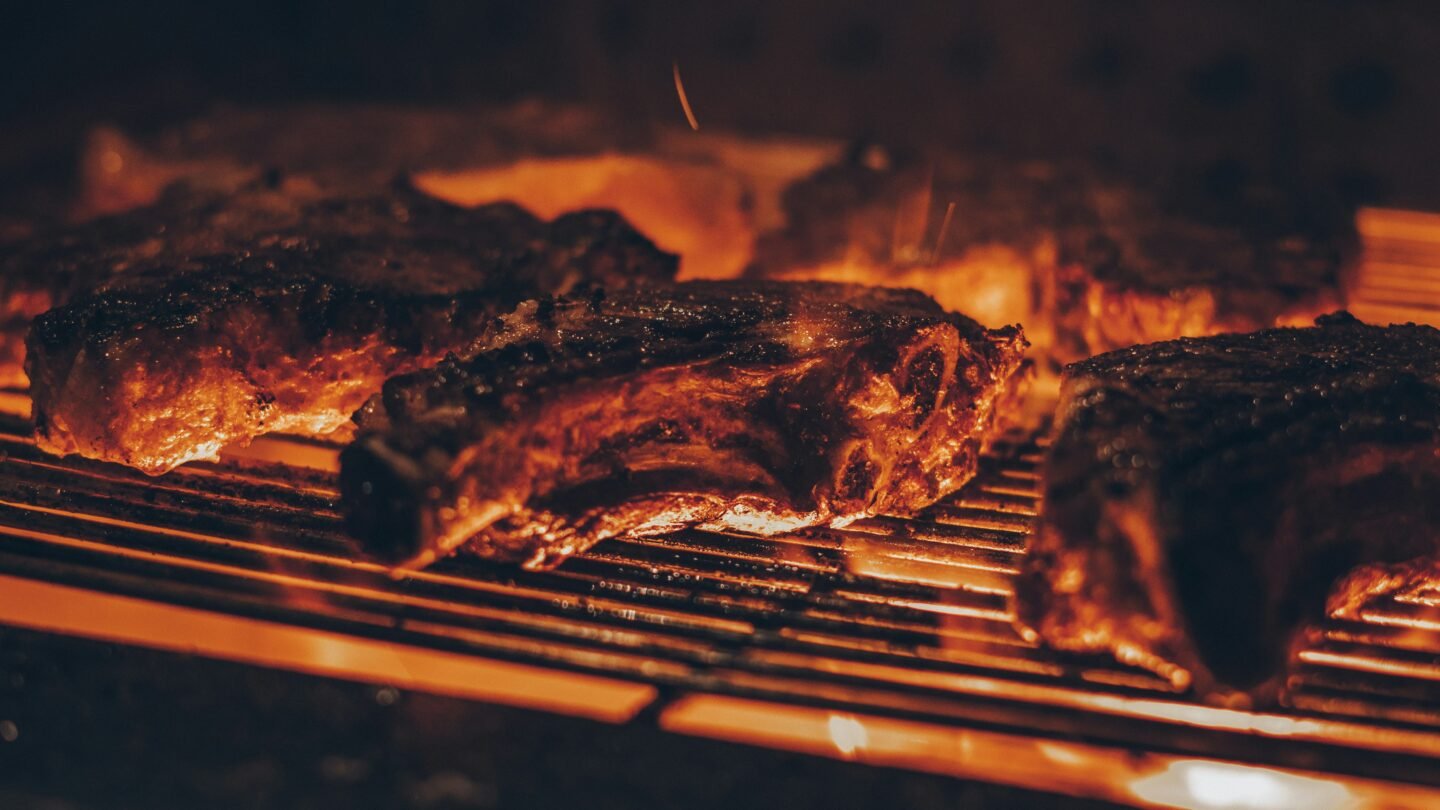
The element heats a ribbed plate to between 200 and 250 degrees. Meat touches metal only along the ridges, and that is where the Maillard reaction runs and the proteins darken. Between the ridges the food steams in its own juices. Hence the stripes.
They are not decoration. Contact cooking transfers heat through metal rather than air, so the surface sets faster than the interior dries out. For a cut of 2 to 3 cm this is the best way to get a crust without turning the middle into leather.
The limitation follows from the same physics. A contact grill copes badly with anything that is not flat. Chicken thighs on the bone, potato wedges, diced vegetables: whatever fails to meet the plate across its whole face cooks unevenly.
Contact, open, combination
Contact. Two plates, both sides cooked at once. A medium steak takes 5 to 7 minutes, a chicken breast 10 to 12. The upper plate rides on a floating hinge that adapts to thickness; where the hinge is rigid, a thick cut gets pressed only at one edge.
Open. A single surface, turned by hand. Roughly twice the time, but large cuts fit and you can watch what is happening. Closer to a barbecue in feel and in result.
Combination, or 3-in-1. The upper plate folds back through 180 degrees, giving two open surfaces. This is the dominant format in Czech retail: almost everything above 2 500 Kč opens flat.
Where the electric grill loses
One function. A grill grills. It will not bake, dry or reheat a finished dish.
Smoke and smell. The phrase “smokeless cooking” in product copy holds only for lean meat. Fatty pork on a plate at 230 degrees produces noticeable fumes, and without extraction the flat will smell of it.
Capacity for two. A plate of 23×15 cm means two steaks or four sandwiches. Cooking for guests means three rounds.
Air fryer: hot air
Basket versus glass bowl
In a basket unit the element sits directly above the food and the fan drives air downwards and back up the walls. The small volume and high air speed produce something close to deep frying: the surface dehydrates faster than the core heats, which is where the crunch comes from.
In a glass bowl the flow is slower and the volume two to three times larger. The result is gentler, closer to roasting. A whole chicken fits in the bowl; it does not fit in a 5 litre basket.
Preheating a basket unit takes 2 to 3 minutes against 10 to 15 for an oven, and that is its main practical advantage over the hob and oven. Heating a full oven for four chicken thighs wastes both time and energy.
What it does beyond grilling
Roasting, baking in small tins, reheating yesterday’s pizza back to something close to fresh, drying fruit and herbs at low temperature, defrosting. Twin-basket models with synchronisation time a main course and a side to finish together.
The limit on that versatility is real rather than rhetorical. A 5 to 7 litre basket cannot replace an oven outright: a 40 cm tray will not go in, a cake for eight will not bake, a goose will not roast. Call it around 70 per cent of everyday tasks, not all of them.
Where the air fryer loses
No bar marks. Circulating air browns evenly and leaves no trace of a grate. For many people that settles the question: the dish looks oven-baked rather than grilled.
Noise. At full speed the fan is comparable to an extractor hood on its second setting, and it runs for the whole cooking time rather than in cycles.
Cleaning. Basket and rack need washing after every use, otherwise burnt fat on the lower mesh starts to smoke. Some models are dishwasher safe and some are not, and that is worth reading rather than assuming.
Head to head across nine parameters
Power, volume and dimensions come from product listings in Czech retail (Datart, September 2026). Cooking times are typical values from manufacturer instructions.
| Parameter | Contact electric grill | Basket air fryer |
|---|---|---|
| Heat transfer | Contact with metal | Forced air circulation |
| Power | 850 to 2 200 W | 1 300 to 2 800 W |
| Preheat | 2 to 3 min | 2 to 3 min |
| Steak, two portions | 5 to 7 min | 15 to 20 min |
| Capacity | 2 to 4 flat portions | 3 to 11 l, 2 to 6 portions |
| Footprint | approx. 35x45x18 cm | approx. 34x27x27 cm (4 l), 40x42x31 cm (11 l) |
| Crust | Striped, high contrast | Even, no marks |
| Noise | None | Constant, fan |
| Cleaning | Removable plates, often dishwasher safe | Basket plus rack, after every use |
What one dinner costs to cook
The formula and the input figures
Consumption is power in watts, multiplied by 0.001, multiplied by time in hours, multiplied by the price per kilowatt hour.
Electricity for Czech households in 2026 runs at roughly 6 Kč per kWh once distribution and all regulated components are included, which is about 0.24 EUR. The energy component alone was around 2.39 Kč per kWh excluding VAT in July 2026. Sources: SPP and the ušetřeno.cz price index. The calculation below uses 6 Kč.
Three scenarios
This is our calculation rather than a measurement: it takes nominal power and full running time, preheating included.
| Dish | Appliance | Time | Consumption | Cost |
|---|---|---|---|---|
| Steak, two portions | Grill 2 000 W | 10 min | 0.33 kWh | 2.0 Kč |
| Steak, two portions | Air fryer 1 700 W | 21 min | 0.59 kWh | 3.6 Kč |
| Chicken thighs, four | Grill 2 000 W | 18 min | 0.60 kWh | 3.6 Kč |
| Chicken thighs, four | Air fryer 1 700 W | 28 min | 0.79 kWh | 4.8 Kč |
| Potato wedges, 700 g | Air fryer 1 700 W | 30 min | 0.85 kWh | 5.1 Kč |
| Potato wedges, 700 g | Oven 2 500 W | 50 min | 2.08 kWh | 12.5 Kč |
Actual consumption will run 20 to 40 per cent below these figures. The thermostat cuts the element once temperature is reached, after which the appliance draws in cycles. The table is an upper bound, not a typical value.
Why energy savings are a weak argument
The gap between the two appliances over one dinner is about 1.6 Kč. Used three times a week, roughly 150 times a year, that comes to 235 Kč of difference across the year. Less than a tenth of the cheapest model.
Savings only become visible against an oven: 12.5 Kč versus 5.1 Kč on the same portion of potatoes. If an air fryer genuinely displaces the oven for everyday cooking, that is around a thousand crowns a year. If the oven goes on at weekends regardless, it is nothing.
What to look at when buying
Power and cooking area
For a contact grill the working minimum is 1 800 W. Units of 850 to 1 000 W, which sell in Czech retail at around 799 Kč, physically cannot hold temperature: cold meat goes on, the plate drops to 150 degrees, no crust forms and the juices run out.
For an air fryer volume matters more than wattage. As a guide: 3 to 5 litres for one person or a couple, 5 to 7 litres for most households, 8 litres and above for batch cooking. Twin-basket units of 10 to 11 litres at 2 700 to 2 800 W are effectively two independent appliances in one shell.
The volume caveat: the stated litres describe the whole basket, not usable load. Food has to lie in a single layer or the airflow does not work. Real capacity is roughly half the number on the box.
Plate coatings and how long they last
PTFE is the cheapest option and scratches under a metal spatula or a hard sponge. In daily use it comes off within 2 to 3 years. Ceramic lasts longer but dislikes thermal shock: cold water on a hot plate produces micro-cracks.
Marble and granite coatings in product copy are the same composite with a mineral filler. It is tougher than plain PTFE, but the seven years quoted assume careful handling rather than the dishwasher three times a week.
Removable parts and real cleaning
The decisive question on a grill is whether the plates come out. Fixed ones have to be wiped over the sink, and within six months the seams hold baked-on residue that cannot be reached.
On air fryers, check the lower mesh of the basket separately. On some models it lifts out, on others it is welded in. Welded means fat accumulates underneath permanently.
Noise, smell, extraction
An air fryer runs at 50 to 65 decibels depending on model and setting. In a studio flat where the kitchen opens onto the living area, half an hour of that is noticeable.
Both appliances release fat into the air as an aerosol. Standing either against a wall without extraction guarantees a sticky film on the tiles within a couple of months. This applies to smokeless models too: no smoke does not mean no aerosol.
Price brackets
Prices observed in Czech retail in September 2026, converted at roughly 25 Kč to the euro.
| Bracket | Contact grill | Air fryer | What appears |
|---|---|---|---|
| Entry | 32 to 64 EUR (800 to 1 600 Kč) | 36 to 48 EUR (900 to 1 200 Kč) | Basic heating, mechanical dial, low wattage |
| Working | 80 to 128 EUR (2 000 to 3 200 Kč) | 72 to 104 EUR (1 800 to 2 600 Kč) | 2 000 W and up, removable plates, 3-in-1 |
| Upper | 160 to 200 EUR (4 000 to 5 000 Kč) | 136 to 164 EUR (3 400 to 4 100 Kč) | Meat probe, automatic programmes, twin baskets |
| Excess | from 236 EUR (from 5 900 Kč) | from 160 EUR (from 4 000 Kč) | Phone app, finish |
The step from entry to working shows up every time you cook. The step from working to upper only pays off if you grill steak more than once a week and want a probe.
What the marketing does not tell you
“Cooks with no oil at all”
Formally true, practically not. Raw potato with no oil at all comes out dry and tough, and vegetables shrivel. A teaspoon per portion is needed nearly always. The claim holds only for food carrying its own fat: chicken skin, pork, oily fish. The same pattern of half-true product claims runs through most small appliance categories, and our soundbar buyer’s guide takes the audio version apart in the same way.
Litres that are not litres
Eight litres on the box is the geometric volume of the basket. Usable load is a single layer of food, roughly 40 to 50 per cent. A twin-basket unit described as 11 litres is two baskets of 5.5 litres, and each loads like an ordinary five litre model.
Automatic programmes
Eight or twelve programmes in the specification means a set of temperature and time presets. There is no recognition of what is inside, apart from the rare models with a probe. The chicken programme will run 200 degrees for 25 minutes regardless of what you put in.
Two things are genuinely useful: a meat probe that cuts the heat by internal temperature, and synchronisation on twin-basket units. Everything else duplicates a manual timer.
Oven comparisons in advertising
Claims along the lines of “saves up to 70 per cent of energy compared with an oven” are calculated against a full oven versus a small portion in the fryer. Compare equal quantities of food and the gap narrows to 30 to 50 per cent, which is still respectable but is a different number.
Verdict: three scenarios
Meat and nothing else. A contact grill in the working bracket: 2 000 W or more, removable plates, 3-in-1 format. Anything dearer adds convenience rather than result.
One appliance for everything, oven rarely used. A basket air fryer of 5 to 7 litres. Twin-basket if the household is larger than two and a side dish goes with every meal.
Undecided. Start with the air fryer. It covers more scenarios, and a steak comes out acceptable on it even without the marks. The reverse order works worse: a grill replaces an air fryer in no scenario except cooking flat meat.
What not to do is buy the cheapest option in either category. A 1 000 W grill and a 900 Kč air fryer do not solve the problem they were bought for, and within six months they end up in a cupboard. The wider habit of checking claims before buying is covered in our guide to smart online shopping.
Frequently asked questions
Is an air fryer the same as a halogen oven?
No. A halogen oven is a glass bowl of 7 to 17 litres with slower air movement and roasting-style results. An air fryer is a small closed basket with fast airflow. Cooking times quoted for one do not transfer to the other.
Can you cook a steak in an air fryer?
Yes, in 15 to 20 minutes instead of 5 to 7 on a grill. The crust comes out even and unmarked, and doneness has to be judged on time: without a probe it is easy to overshoot medium into well done.
Which is cheaper to run?
The contact grill, by about 1.6 Kč per dinner at 6 Kč per kWh. Across a year of three uses a week that is roughly 235 Kč. It should not decide the purchase.
Will an air fryer replace an oven?
For everyday cooking, roughly 70 per cent of it. It will not in three cases: large trays, baking for a group, and whole poultry. A 5 to 7 litre basket is physically smaller than the smallest oven.
How many watts are enough?
A contact grill needs 1 800 W or more, otherwise the plate cannot hold temperature under cold food. An air fryer needs from 1 300 W for volumes up to 5 litres and from 1 700 W for 6 to 8 litres.
How noisy is an air fryer?
Between 50 and 65 decibels, comparable to an extractor hood at medium speed, and it runs throughout. Noticeable in a studio flat, not in a separate kitchen with the door shut.
What should I search for in a Czech shop?
Contact grill is kontaktní gril. Basket air fryer is horkovzdušná fritéza or horkovzdušný fritovací hrnec. An open tabletop grill is elektrický gril.
We cover household appliances on the same basis throughout: mechanics, real EU prices, and limitations in place of marketing phrases. Subscribe to the newsletter if you want the next breakdowns as they appear.