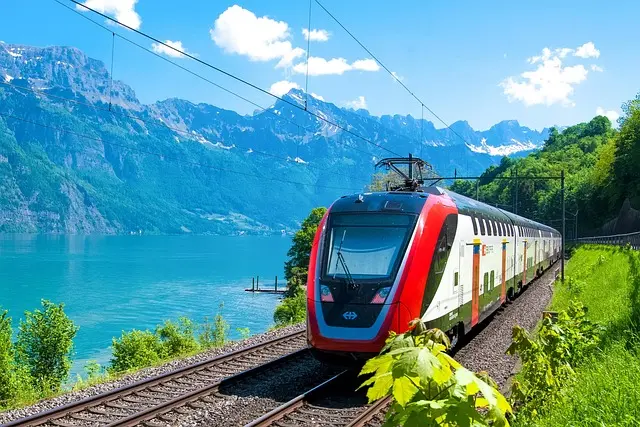
Rail travel across Europe is having a renaissance. Rail passenger numbers grew 27% compared with 2023 — and that’s no accident. The flygskam (flight shame) movement, the EU’s climate goals, and real investment in infrastructure have made the train not a compromise but a deliberate choice for millions of travellers. The EU is directing more than €100 billion toward rail network modernisation through 2030. The high-speed network is expanding: Spain is finishing new AVE lines, Rail Baltica will connect the Baltic states with Poland, Germany is rolling out new ICE 3neo trainsets. ÖBB Nightjet has launched dozens of overnight routes — from Brussels to Barcelona, from Amsterdam to Rome. This guide gives you the full picture of European rail tourism in 2026: TOP-10 scenic routes, comparison with aviation, Interrail for unlimited travel, booking platforms, and practical money-saving tips.
Why Europeans Are Choosing Trains in 2026
Flygskam and Environmental Awareness
The Swedish concept of “flight shame” has spread well beyond Scandinavia. According to 2025–2026 surveys, 72% of Europeans aged 18–35 prefer the train over the plane on routes under 1,000 km — when the time difference is less than two hours. Ten years ago that figure was below 45%. Several EU countries have introduced or expanded short-haul flight bans. France has banned flights since 2023 where a rail alternative takes less than 2.5 hours. Austria and the Netherlands are moving in the same direction. The European Commission proposed unified standards for the bloc in 2025 — a decision is expected in 2027.
Investment in Rail Infrastructure
Rail Baltica — Europe’s largest infrastructure project of recent years — moved into the active construction phase by 2026: the Estonian and Latvian sections are 60% complete, the Polish section 45%. The first segments are expected to open in 2028–2029. The Tallinn–Warsaw route will take 5 hours instead of the current 12+ by car. Germany has invested €30 billion in the Deutschlandtakt programme — a national clock-face timetable with synchronised schedules across the country. Deutsche Bahn (DB) is rolling out new ICE 3neo trainsets with 5G Wi-Fi, improved seating, and 25% lower energy consumption. Switzerland’s SBB traditionally remains the punctuality benchmark with 92% on-time arrivals.
Lifestyle and the Slow Travel Culture
The #traintravel hashtag has racked up over 4 billion views on TikTok by early 2026. “Train content” — window views, dining-car shots, arrival shots at iconic stations — has become a travel-blogging genre in its own right. Interrail is booming among Gen Z: 2025 was a record year for pass sales — 700,000 passes. The 2026 figure is expected to be even higher. The slow-travel philosophy — not rushing from A to B but watching the landscape change — finds an audience among those tired of airports.
Advantages of Rail Travel
Sustainability: 2026 Data
A train produces between 12 and 38 grams of CO₂ per passenger per kilometre — depending on the country and the source of electricity. A plane produces 260–290 grams over the same distance. The gap is 7 to 22x. Running on renewable energy (as in Switzerland, Austria, and Norway), the train leaves practically no carbon footprint. In 2026, 67% of the European rail network is electrified, and the share of renewable energy powering trains keeps growing. Switzerland runs on 100% hydropower, Norway on the same. Austria and Sweden have already cleared 85% green energy share.
Comfort Beats Aviation
A train passenger can stand up and walk around, use a spacious toilet, work at a table with a power outlet, eat in the dining car. On a 2–3 hour flight, this is unavailable or severely limited. ICE and TGV offer Wi-Fi at 100–300 Mbps — enough for video calls.
Centre to Centre: Real Time Savings
Paris–Amsterdam: the Thalys leaves Gare du Nord and arrives at Amsterdam Centraal in 3 hours 15 minutes. The plane: 50 minutes airborne plus 1.5 hours to CDG, 1.5 hours to Schiphol, check-in and security — totalling 4.5–5 hours. Barcelona–Madrid: AVE Renfe — 2 hours 30 minutes between central stations. The plane — the same 2.5–3.5 hours when factoring in airport overhead. And the train comes with no baggage fees, no shoe screening, no trip out to the suburbs.
Panoramic Views as Part of the Experience
The Zurich–Milan route through the Alps is impossible to replicate in the air: the Gotthard tunnel, the switchbacks of Ticino canton, the shift from German-speaking Switzerland to Italian — all part of the journey, not dead time. The Bergen–Oslo line over the Hardangervidda plateau or Copenhagen–Stockholm across the Øresund bridge are similar examples.
Productivity and No Stress
The station is in the city centre, reachable in 20–30 minutes. Arriving 15–20 minutes before departure is enough. No airport-style security, no flight mode. A 2025 study by the German Institute of Labour Economics found that business travellers on the ICE complete 65% of work tasks during the journey — versus 18% on a plane.
2026 Transport Comparison
| Criterion | Train | Plane | Bus |
|---|---|---|---|
| Carbon footprint (CO₂ g/pax/km) | 12–38 g | 260–290 g | 65–100 g |
| Speed (Paris–Amsterdam ~500 km) | 3 h 15 min direct | 1 h 15 min + 3 h (airports) = 4.5+ h | 7–8 hours |
| Comfort | High (freedom of movement, space) | Low–medium (cramped, restrictions) | Low (very tight, slow) |
| Productivity | High (Wi-Fi, table, outlet) | Low (takeoff/landing, noise) | Low (stops, shaking) |
| Price (typical 2026) | €55–160 | €45–220 (without baggage) | €22–55 |
| Baggage | No limits, free | Paid €25–60 | Limited or paid |
| Change flexibility | Medium (depends on fare) | Low (fees €40–100) | Low |
TOP-10 Scenic Routes Across Europe in 2026
1. Paris — Amsterdam (Thalys/Eurostar)
Travel time: 3 hours 15 minutes. From €35 with early booking. The route runs through scenic northern France and Belgium — with an optional stop in Brussels. The central stations of both cities sit in the very heart, making the journey maximally convenient.
2. Zurich — Milan via the Alps (SBB/Trenitalia)
Travel time: 3 hours 20 minutes. €45–85. The Gotthard Base Tunnel — the longest in the world (57 km) — lets the train cut straight through the Alps. The sections before and after the tunnel are a real Alpine spectacle of switchbacks, viaducts, and viewpoints.
3. Barcelona — Madrid (Renfe AVE)
Travel time: 2 hours 30 minutes. €30–90 booked 2–4 weeks ahead. The Spanish AVE network in 2026 is Europe’s largest in high-speed track length. The line runs across the plains of Aragón and Castile — an arid yet monumental central-Spanish landscape.
4. Vienna — Budapest (ÖBB/MÁV)
Travel time: 2 hours 40 minutes. €20–55. The route links two imperial capitals with deep architectural histories. Austrian suburbs give way to the Great Hungarian Plain — wide horizon, distinctive Central European aesthetic.
5. Rome — Florence — Venice (Trenitalia Frecciarossa)
Rome–Florence: 1 hour 25 minutes. Florence–Venice: 2 hours 5 minutes. €25–70 per segment. The Frecciarossa runs every hour, giving maximum flexibility. The Italian high-speed network in 2026 is one of Europe’s densest.
6. Prague — Berlin (DB/ČD)
Travel time: 4 hours 15 minutes. €30–75. The route through the Krkonoše mountains and Saxon Switzerland is one of Central Europe’s most scenic. The Elbe valley on the German section, with castles on rocky banks, is an unmissable view.
7. Copenhagen — Stockholm (SJ)
Travel time: 4 hours 55 minutes. €45–95. The train crosses the Øresund Bridge — an 8-kilometre structure linking Denmark and Sweden directly over the water. After that — a Scandinavian landscape: lakes, conifer forests, the distinctive northern architecture of small towns.
8. Munich — Salzburg — Vienna (DB/ÖBB Railjet)
Travel time: 4 hours 5 minutes (Munich–Vienna direct). €30–80. The Railjet route runs through the Bavarian foothills, the Salzkammergut lake district near Salzburg, and the Austrian Alpine foreland on approach to Vienna. One of Central Europe’s most rewarding cross-border lines, linking three culturally rich cities in a single journey.
9. Lisbon — Porto (CP Alfa Pendular)
Travel time: 2 hours 50 minutes. €25–55. The route runs along the Atlantic coast and the Tejo river valley — a quintessentially Portuguese landscape with vineyards, Atlantic flora, and whitewashed villages. The Alfa Pendular is one of the Iberian Peninsula’s most comfortable trains.
10. Edinburgh — London (LNER Azuma)
Travel time: 4 hours 20 minutes. £35–110. The East Coast Main Line is among Britain’s most scenic: the North Sea coastline at Berwick-upon-Tweed, Northumberland castles, the Yorkshire dales. The LNER Azuma offers one of the better comfort standards in its class among European trains.
European High-Speed Trains in 2026
TGV (France) — SNCF
The TGV — pioneer of high-speed rail, in service since 1981. In 2026 SNCF puts the TGV M (Avelia Horizon) into commercial service — a new generation with increased capacity (+20%), quieter cabins, and charging stations at every seat. Maximum commercial speed — 320 km/h. Prices from €25 with early booking up to €180+ on peak dates. The TGV network covers the whole of France and connects with Spain, Italy, Germany, and Belgium.
ICE (Germany) — Deutsche Bahn
The ICE 3neo — Deutsche Bahn’s flagship since 2022 with mass deployment in 2025–2026. Speed up to 320 km/h, 5G Wi-Fi, seamless glazing for the best window views, 30% noise reduction versus the previous generation. The ICE network links Germany’s largest cities and reaches Austria, Switzerland, France, Belgium, and the Netherlands. The BahnCard 25/50 programme cuts prices 25–50% for regular passengers.
AVE (Spain) — Renfe
Spain has built Europe’s largest high-speed line network — over 4,000 km. Renfe expanded the route map: 2026 sees new sections opened in Andalusia and along the Mediterranean coast. The Ouigo España service — TGV’s budget cousin running on Spanish track — offers tickets from €9 with early booking.
Frecciarossa (Italy) — Trenitalia
The Frecciarossa 1000 — among Europe’s fastest trains in commercial service (max 400 km/h, commercial 300 km/h). Four service classes: Standard, Premium, Business, Executive. Italo — Trenitalia’s private competitor — creates healthy competition and brings prices down on the main routes (Rome–Naples, Rome–Florence, Milan–Turin).
Eurostar and Thalys
Eurostar links London with Paris (2 h 15 min), Brussels (1 h 55 min), and Amsterdam (3 h 52 min) via the Channel Tunnel. Thalys (rebranded as Eurostar International from 2024 after the merger) runs the high-speed link between Paris, Brussels, Amsterdam, and Cologne. Prices from €35 with booking 3+ months ahead.
Interrail and Eurail 2026: Unlimited Travel
What It Is and How It Works
Interrail is a pass for citizens and residents of European countries, allowing travel on trains in 33 countries during a chosen window. Eurail is the equivalent for travellers from outside Europe. The pass doesn’t guarantee a seat — high-speed trains (TGV, ICE, Eurostar, Thalys) require a separate seat reservation at €10–35 depending on the route.
Pass Types and 2026 Prices
The Global Pass gives access to the network of all 33 countries. Youth (under 27) — from €280 for 7 travel days within a month. Adult — from €375 for the same format. Senior (60+) — from €340. Continuous Pass (unlimited travel for 15, 22 days, or 1, 2, 3 months) — higher cost, justified for intensive itineraries. One Country Pass — single-country pass: Germany, France, Italy, Spain — from €108 for 3 days.
Is Interrail Worth Buying in 2026
The maths is simple. On a Warsaw–Berlin–Amsterdam–Paris–Barcelona–Rome route over two weeks, regular ticket purchase runs €180–260. A Global Pass for 7 days at €280–375 only pays off when adding 2–3 extra legs or making frequent spontaneous trips. For students under 27, the gap is smaller — the Youth fare is competitive. Rail Planner — Interrail’s official app — lets you map out the route and calculate the savings before buying.
2026 Booking Platforms
Operator Websites
Booking directly on the operator’s site is the best route for a specific journey within one country. SNCF, DB, Trenitalia, Renfe, and ÖBB offer the best prices on their own platforms. The downside — a separate site for each country and, as a rule, the lack of a multilingual interface.
Aggregators: Omio, Trainline, Rail Europe
Omio (Germany) bundles trains, buses, and flights into a single search — particularly handy for multimodal journeys. Trainline (UK) specialises in rail tickets across Europe with proper option comparison. Rail Europe is a dedicated platform for booking European trains from anywhere in the world, including Interrail and Eurail. Aggregators charge a €1–5 commission per ticket, but save time on complex itineraries.
Choosing a Platform
One simple journey within a country — the operator’s site. International route with several legs — Omio or Trainline. Multi-leg tour over 2+ weeks — Interrail through Rail Europe. Route involving the UK — Eurostar and Trainline.
How to Find Cheap Tickets in 2026
Book Ahead
TGV, ICE, and Eurostar open sales 90–120 days in advance. The cheapest fares go first: a Paris–Lyon TGV at €19 exists, but only in the lowest class on 5–7 specific departures a day. Booking 2–3 months out delivers an average 40–55% saving versus the price 3 days before travel.
Flexible Dates and Times
Mid-week departures (Tuesday–Wednesday) are 20–35% cheaper than Friday and Sunday. Early-morning departures (5–7am) and late-evening ones (9–11pm) also offer lower fares — demand is lower. DB and SNCF show a date-price matrix right on the website — the rail equivalent of an airline price calendar.
Night Trains: Transport Plus Hotel
The night train saves on a hotel and on travel at the same time. A Nightjet sleeper berth from Vienna to Berlin costs €59–89 — comparable to a budget hostel, but the bed is included. Comparing “flight + hotel night” vs. “night train”, the second often comes in €30–70 cheaper.
Group Tickets and Discounts
DB offers Sparpreis Europe — a fixed price of €19.90–39.90 for early bookings to any European country. Group tickets (3+ people) on SNCF and ÖBB give an additional 10–25%. Children under 14 on most European networks travel free with a parent holding a full ticket.
Night Trains: The Nightjet Renaissance
Sleeper Types
ÖBB Nightjet offers three formats. Seated carriage — from €29, only recommended for trips of up to 5 hours. Couchette (open berth, six-bed compartment) — bedding included, from €49. Sleeper (private compartment for 1–3 people) — with breakfast, from €79 to €169. Showers and washbasins — in dedicated cars on most Nightjet routes.
Popular Routes in 2026
ÖBB Nightjet runs more than 25 routes in 2026. New destinations launched in 2024–2026: Brussels–Berlin, Amsterdam–Barcelona (in partnership with Renfe), Zurich–Rome with extra stops. The European night-train network is expanding: European Sleeper has launched a Brussels–Prague route, Snälltåget runs the Stockholm–Berlin overnight in summer.
The Romance of Slow Travel
Falling asleep in Vienna and waking in Rome isn’t a metaphor — it’s the actual Nightjet schedule, arriving around 9:30am. The night train delivers what the plane can’t: a smooth transition between cities, breakfast to the rhythm of the wheels, and a view of dawn over the Italian hills.
Environmental Aspect: 2026 Data
Contribution to EU Climate Targets
The European Green Deal sets a target to double rail traffic by 2030 versus 2015. By 2026, Europe has covered roughly 60% of the way to that figure. Passenger growth is outpacing forecasts, and the network keeps expanding. Rail accounts for just 0.5% of the EU’s transport emissions while delivering 8% of passenger turnover — an efficiency ratio aviation can’t match.
Electrification and Renewable Energy
67% of European rail track is electrified in 2026. Switzerland (100% hydropower), Austria (80%+ renewable), and Norway (100% hydropower) operate effectively carbon-neutral systems. Germany hit 60% renewable energy in the grid by 2026 — directly improving DB’s environmental footprint. Omio and Trainline now show a CO₂ estimate for every route right in search results.
Hydrogen Trains
Germany launched the world’s first regular commercial hydrogen-train route on Alstom Coradia iLint sets in Lower Saxony in 2022. By 2026 the fleet has grown to 27 trainsets across 4 regional routes. The Netherlands is testing hydrogen trains on non-electrified sections. Alstom’s projection: hydrogen trains will appear in 10+ European countries by 2030 — primarily on lines where electrification doesn’t pay off.
Safety and Reliability
Safety Statistics
The train is 28 times safer than the car by fatalities per billion passenger-kilometres. According to ERA (European Union Agency for Railways), European rail logs less than 0.14 deaths per billion passenger-kilometres — among the best figures in the world.
Punctuality by Country in 2026
Switzerland (SBB) — 92.4% on-time arrivals. Austria (ÖBB) — 86%. Netherlands (NS) — 88%. Germany (DB) — 78% (a historical pain point, up 4% over the past year thanks to investment). Italy (Trenitalia Frecciarossa) — 82%. United Kingdom (LNER) — 74%.
EU Passenger Rights
EU Regulation 2021/782 guarantees: 60–119 minute delays — 25% ticket compensation; 120+ minutes — 50%. Right to meals at delays of 60+ minutes. Right to a hotel at delays forcing an overnight away from home. Compensation is requested through the operator’s website form or via Trainline/Omio if booked through an aggregator.
Accessibility for Different Traveller Groups
Students and Youth
Interrail Youth Pass (under 27) — the basic tool for the famous “European summer trip”. The DB BahnCard 25 costs €57.90 a year and shaves 25% off every DB ticket — pays back in two Berlin–Munich journeys. SNCF offers the Avantage Jeune card (under 27) with a similar mechanism.
Seniors
Interrail Senior Pass (60+) — from €340. DB Senior (60+) — BahnCard 50 at €122/year gives a 50% discount on every ticket. Most European countries have national senior discount programmes — from 25% off to free travel in some cases.
Families
Children under 14 in most EU countries travel free with a parent holding a full ticket. The DB Family Card grants free travel for all the children in the family. Family compartments with play zones are available on the ICE and TGV. Pushchairs and bicycles travel free.
People with Reduced Mobility
European rail companies are required to provide boarding and alighting assistance with prior notice (typically 48 hours). The new ICE 3neo and TGV M trainsets are fully adapted: wide aisles, dedicated spaces, electric platform lifts.
Practical Tips for 2026
Seat Reservations
On high-speed trains (TGV, ICE, Eurostar, AVE, Frecciarossa), a seat reservation is mandatory or strongly advised, even with Interrail. Cost €10–35 depending on the route. On regional trains, no fixed seat — first come, first served.
Baggage Without Limits
Most European networks set no formal weight limits on hand luggage and suitcases — provided the passenger can manage their own bags. Bicycles travel in dedicated sections (reservation recommended). Skis usually travel free in a bag.
Wi-Fi and Apps
Wi-Fi is available on most high-speed trains. Speeds vary: ICE 3neo and TGV M deliver a stable 100+ Mbps. Regional trains — patchy or absent. Rail Planner (Interrail’s official app), Omio, and Trainline are the three main planning tools. Seat61.com — unofficial but exceptionally detailed resource on every European route.
The Future of European Railways
New High-Speed Lines
Lyon–Turin: a Franco-Italian high-speed tunnel under the Alps, due to open in 2032, will cut journey time from 3.5 to 2 hours. Rail Baltica: opening of the first Warsaw–Kaunas sections is expected in 2028. Spain continues building new AVE lines — by 2030 the network will grow by another 1,500 km.
Autonomous Trains
SNCF has been testing automated control on TGV lines since 2025: the goal is to reduce headways and lift punctuality. Fully autonomous trains on intercity routes — projected for 2030–2035. Metros and commuter rail with full automation are already in operation (Copenhagen, Rome, Lyon).
Mobility as a Service (MaaS)
Integrating rail, urban transport, car-sharing, and bike-sharing into a single digital ticket — the MaaS programme is moving fast in Finland, the Netherlands, and Germany. Buying one “door-to-door” ticket through a single app is reality in several urban regions today. The EU plans pan-European interoperability standards by 2028.
Nightjet Network Expansion
ÖBB plans to expand the Nightjet network to 30+ routes by 2030. Priority links: Berlin–Madrid, Amsterdam–Rome, Warsaw–Vienna. New night-train sets, developed with Siemens, start delivery from 2026 — with upgraded compartments, showers, and 5G Wi-Fi.
Bottom Line
Travelling Europe by train in 2026 isn’t a romantic alternative to “real” transport. It’s a practical, often faster, more sustainable, and more comfortable way to move between European cities. The data backs it up: on routes up to 1,000 km, the train beats the plane on overall criteria most of the time. TGV and ICE are building new lines. Nightjet is expanding the night network. Interrail opens 33 countries to travellers under 27. Omio and Trainline make multi-segment booking as easy as searching flights. Every rail ticket bought on a route where the option exists is a concrete vote for lower emissions: 7–22 times less CO₂ than aviation.
Liked the article? Subscribe to our blog to catch new pieces on travel, sustainable tourism, and tips for exploring Europe. Share your rail-travel experience in the comments — which route stuck with you most?