A consumer exoskeleton is a wearable, motorised device that straps around your waist and thighs and adds force to your own steps: a climb, a long trail or a staircase suddenly demands noticeably less effort. Five years ago exoskeletons lived in two worlds — factory floors and rehabilitation clinics. By 2026 a third has appeared: devices weighing around two kilogrammes, priced from $400 to $2,000, that an ordinary person buys on Amazon much like an e-scooter. In this guide we break down how the technology works physically, what it really delivers (and what it does not), who it suits, how much it costs and which pitfalls to check before buying.
How a consumer exoskeleton differs from industrial and medical ones
The word “exoskeleton” covers three very different classes of hardware, and confusing them is the main source of inflated expectations.
Industrial exoskeletons are built for work: to unload a labourer’s back, or to hold an installer’s arms raised at the ceiling. Often they are entirely passive constructions — springs and levers with no motors. They are designed for an eight-hour shift and bought by companies, not individuals.
Medical exoskeletons are rehabilitation systems that let people with paralysis walk again or recover after a stroke. This is certified medical equipment costing tens of thousands of dollars, prescribed by a doctor and used under specialist supervision.
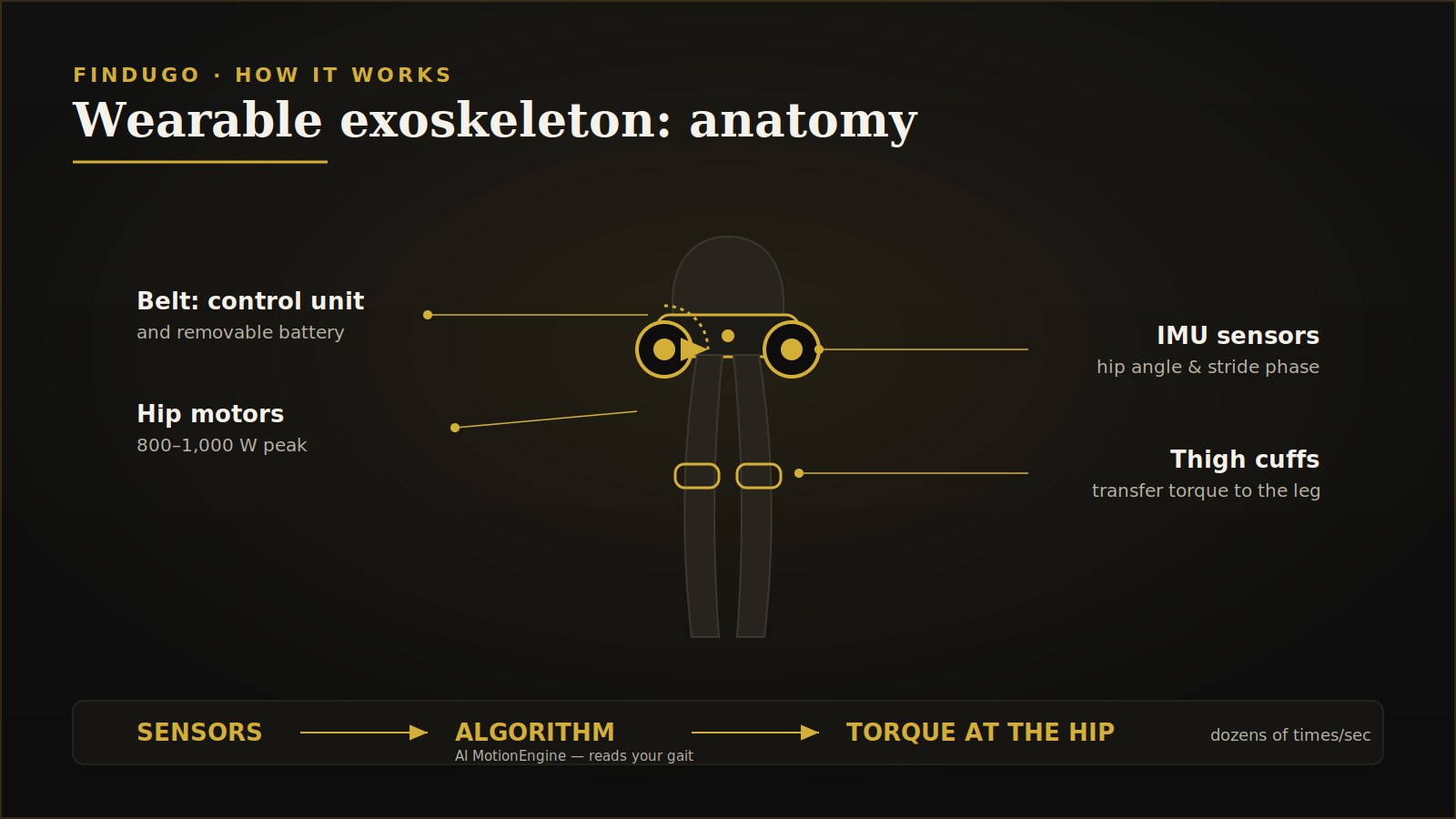
The consumer (wearable) exoskeleton is the youngest class. It does not replace your legs and it does not treat anything: it *assists* a healthy or mobility-limited person in ordinary movement. The typical 2026 design is a belt with a control unit and battery, two motors on either side of the pelvis, and cuffs on the thighs. Weight runs from about 1.8 to 2.6 kg, and running time from a few hours to a full day of hiking. The key difference from the “senior” classes is a consumer-electronics price and direct sale — no corporate procurement, no medical prescription.
An important shift of recent years: the market has moved from stationary clinical systems towards mobile wearable devices for “real” movement — streets, trails, travel. According to industry forecasts (MarketsandMarkets), the exoskeleton market as a whole will grow from $0.56 billion in 2025 to roughly $2.03 billion by 2030 — around +29% a year — with powered devices the fastest-growing segment at about 32% a year. Europe holds the largest share of that market, at roughly 35%.
How a wearable exoskeleton works: motors, sensors and the algorithm
The principle is simpler than it sounds. The device solves three tasks: work out which phase of your stride you are in, predict the next movement, and add torque at the hip at the right moment.
Motors. Two brushless electric motors with reduction gears sit on either side of the pelvis. On flagship models peak power reaches 800–1,000 W — for comparison, that is the power class of an average e-bike motor. The motor does not “move your leg for you”: it adds torque to a movement you have already started.
Sensors. Inertial sensors (accelerometers and gyroscopes) plus motor-position sensors measure hip angle, speed and the character of the movement dozens of times a second: level walking, climbing, descending, running, stairs.
Algorithm. The software model — Hypershell calls it AI MotionEngine — recognises an individual’s gait pattern and tunes the torque and timing of the assistance to it. It is precisely the algorithm that separates a proper device from “a motor on a strap”: the help must arrive in the right phase of the stride, otherwise the exoskeleton gets in the way rather than helping. Mature models offer a set of modes (eco, trekking, climbing, running) and a “transparent” mode in which the motors simply do not resist your movement.
Power. A removable lithium-ion battery in the waist unit. Realistic range for mainstream models is 15–17.5 km of assisted walking; flagships claim up to 30 km, though on maximum assistance the range can drop to about 5 km. Range figures, as with electric cars, depend heavily on mode, terrain and temperature: mature models claim an operating range down to −20 °C, but in the cold the capacity of any lithium-ion battery sags. Batteries are swappable — for a long route, experienced users carry a spare.
Putting the device on and taking it off is a one-minute job: the belt fastens like a rucksack hip belt, and the cuffs use velcro or side-release buckles. Control is via a button on the body and through a smartphone app, where modes are selected and firmware is updated.
What an exoskeleton really delivers — and what it does not
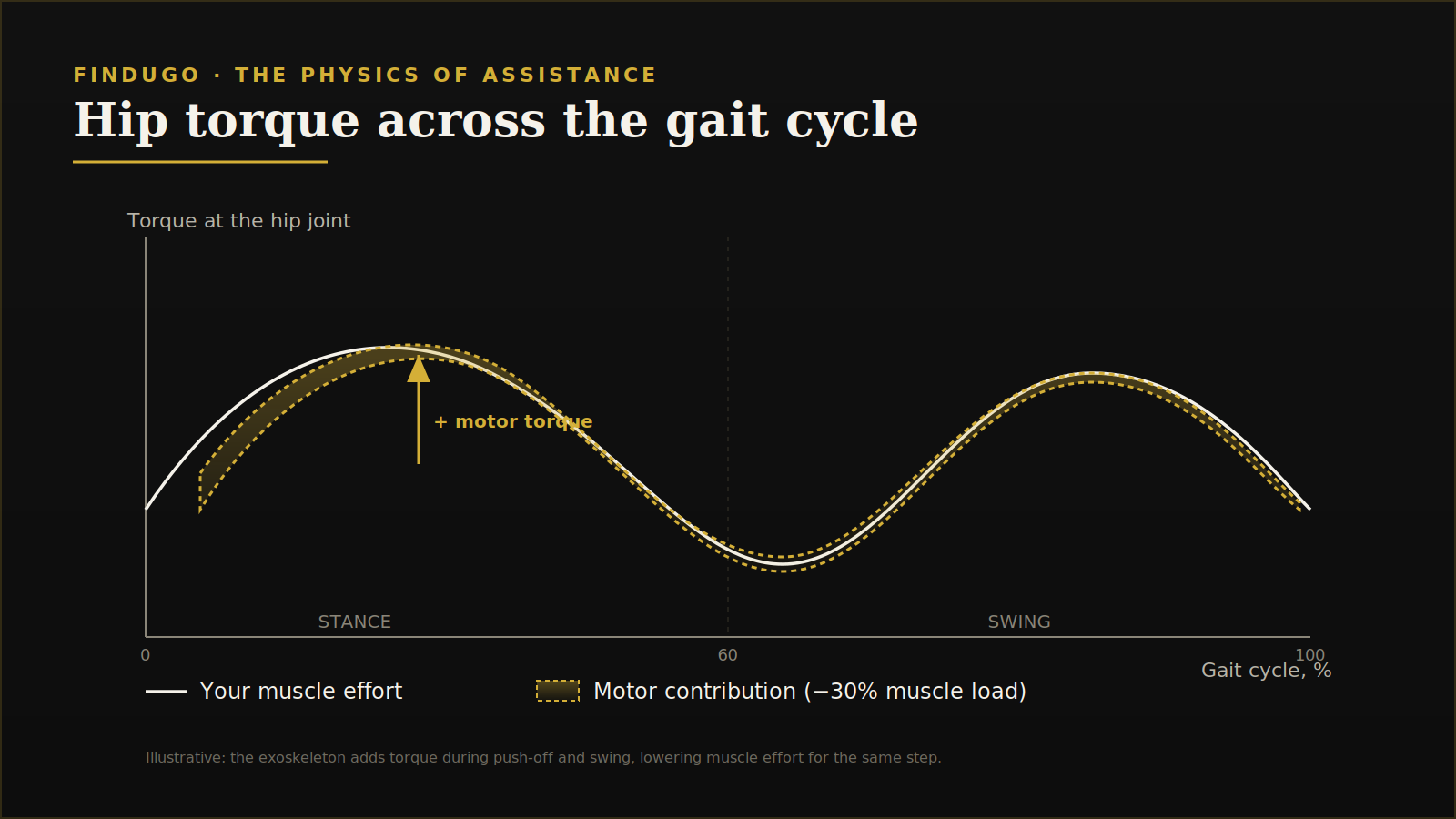
Let’s start with the physics, because it is more honest than the marketing. When you walk, most of the work is done by the hip flexor and extensor muscles: on every step they create a torque at the hip joint that lifts and swings the leg through, and on a climb also lifts your body weight against gravity. The exoskeleton adds its own motor torque to that joint torque. Your muscles have to produce less effort for the same step — hence the “light legs” effect.
What that gives in numbers: the category leader claims a reduction in muscular effort of around 30% and a boost in effective “leg strength” of around 40%. Importantly, this is not just promo copy: Hypershell’s performance claims passed certification by the independent laboratory SGS — the first such case for an outdoor consumer exoskeleton. In practice users describe the effect like this: a climb that used to force a stop every 200 metres is walked at a steady pace; after 15 km in the mountains there is energy left.
Now for what the device does not give — this matters more for the buying decision:
- It is help for the legs from the waist, not a power suit for the whole body. It does not unload your back, shoulders or arms; a heavy rucksack stays heavy.
- It does not turn an unfit person into a marathon runner. Your heart and lungs are still yours; it reduces muscular load, not the need for endurance.
- It does not remove the load from your knees entirely. Torque is added at the hip; knees and ankles keep working, though subjectively many find descents easier.
- The effect depends on terrain. Maximum benefit comes on climbs and long distances; on a flat stroll through the park the difference is barely felt.
A word on adaptation. For the first 20–30 minutes, walking with the assistant feels unfamiliar: the motor “nudges” the hip slightly earlier than you expect. The algorithm needs time to learn your gait, and you need time to stop resisting the help. Users consistently describe the same threshold: after the first or second walk the device “disappears”, leaving only the sense that walking is easier. Don’t plan your first serious route for the day you buy it — give yourself a couple of short outings to adapt.
Who a consumer exoskeleton suits
The category was created not for gadget geeks but for quite specific scenarios.
Hikers and trekkers. The main audience. Multi-day routes, elevation gain, fatigue in the second half of the day — exactly where 30% less effort turns into real kilometres. It is no accident that flagship models are tested on Everest-grade routes and in the Scottish highlands.
Active older people. For those aged 60+, an exoskeleton means not having to shorten familiar routes: walking with grandchildren, carrying on hiking, not fearing stairs and climbs. It is not a medical device, but this is the group that most often writes the strongest reviews. A telling case the company itself cites: 60-year-old Robert McComb, forced by asthma and age to give up long-distance hiking, walked the 154-kilometre West Highland Way in Scotland in a Hypershell X Carbon, averaging 32 km a day — including the notorious “Devil’s Staircase” — and never once reached for his inhaler along the entire route.
People with limited mobility. Where the ability to walk is preserved but fatigue sets in quickly (age-related sarcopenia, recovery after injury — in agreement with a doctor), assistance extends the reachable distance. The line with medicine is fundamental here: a consumer device is not prescribed and does not replace rehabilitation.
Runners and trail runners. A niche but growing scenario: assisted training on long climbs, recovery runs. Some models also support a cycling mode.
Workers “on their feet”. Couriers, tour guides, warehouse and site staff — those who cover 15–20 km a day at work. Here consumer models start to compete with industrial ones on price at comparable benefit to the legs.
Who an exoskeleton is not for: when it’s overpaying
An honest section you rarely meet in reviews.
- You walk less than 5 km a day on flat city ground. The assistance effect on short, level distances is minimal — the device will sit in the cupboard more than it works.
- You expect an “Iron Man suit”. An exoskeleton will not let you jump higher, lift heavy loads or run at 30 km/h. If the motivation is “superpowers”, a thousand-dollar disappointment awaits.
- You want it to replace training. The logic is the opposite: the device reduces load, it does not build muscle. To strengthen your legs, plain walking without an assistant is cheaper and better.
- Budget is critical. For most buyers this is still a luxury, not a necessity: the same thousand dollars, put into lightweight kit and trekking poles, gives comparable comfort for weekend hikes.
A simple rule: an exoskeleton pays for itself in experiences where you regularly have long distance plus elevation gain plus fatigue that limits you. If at least two of those three are missing, it is most likely overpaying.
How much a consumer exoskeleton costs and why it’s so expensive
The market range for 2026 is roughly $400 to $2,000.
- Budget entry (~$400–700): promotional prices on the DNSYS X1, the base Hypershell X Go (~$599–999 depending on configuration and sales).
- Mid-range (~$700–1,100): Hypershell X Pro / X Carbon, the current X Pro S at $999 — the “value for capability” sweet spot for most.
- Flagships (~$1,400–2,000): Hypershell X Ultra and the new S-series (X Max S $1,499, X Ultra S $1,999) — peak power of 1,000 W, up to 30 km of range, up to 12 intelligent modes.
To the device price you should add the real cost of ownership. A spare battery for long routes is usually $100–200 separately; over time you add replacement of the main one too: lithium-ion cells last hundreds of cycles, which under heavy use is 2–3 seasons. If you plan multi-day hikes, budget for these items up front, not just for the box price.
Why so expensive. First, the hardware: two geared motors, power electronics, a lithium-ion battery and a frame — in bill-of-materials terms that is closer to an e-bike than a fitness band. Second, the software: years of developing gait-recognition algorithms. Third, volume: even the market leader sells in the tens of thousands of units, not the millions — the economies of scale of consumer electronics are not there yet. The good news: the category is maturing and by 2026 already behaves like ordinary electronics — sale discounts, spare-battery bundles, coupons. Entry prices fall with each generation.
Key players in the market in 2026
Hypershell is the obvious category leader. The company was founded in 2021 in Shanghai and started with a Kickstarter campaign in 2023 ($1.23 million, 2,638 backers). By May 2026 — a $50 million Series B+ round from Ant Group and Meituan, total investment of $120 million and a valuation of around $400 million. Tens of thousands of units sold (per the company); the line ranks first for sales in the category on Amazon in the US and Europe. The technology base is the Omega architecture and the AI MotionEngine algorithm; an IP54-rated body with an operating range down to −20 °C. In 2026 the company refreshed the line-up with an S-series (X Pro S, X Max S, X Ultra S).
DNSYS is the main challenger in the budget segment: the X1 model for the hips and the Z1 for the knees, aggressive pricing and bundles.
Ascentiz offers the modular H Pro, still at pre-order stage: an interesting architecture, but a product not yet proven by mass users.
Beyond these, MeBotX, YRobot, Crimson Dynamics and others are entering the category — a sure sign that the niche has stopped being one company’s experiment and is turning into a full segment of consumer electronics.
If you’re weighing up wearable electronics more broadly, choosing by scenario rather than by advertising promises works in adjacent categories too. When picking fitness watches, for instance, we covered that logic in our guide to Huawei Watch Fit 2 versus Amazfit Bip 6 — there too it isn’t the most “loaded” model that wins, but the one that matches your tasks.
Pitfalls: what the promo videos keep quiet about
The battery and flying. An exoskeleton’s lithium-ion battery cannot go in checked baggage — carry-on only, and even then within the airline’s capacity limits. For a device bought primarily for travel, that is a notable constraint: you’ll have to plan flights around a specific carrier’s rules.
The fit isn’t universal. The straps are designed for an “average” build. On very slim users the cuffs may not tighten enough — there are cases where straps need adjusting or re-stitching. Before buying, check the size chart and read reviews from people of a similar build.
The weight rides on your pelvis. 1.8–2.6 kg is not much, but it is constant kilogrammes on the waist. Keep your first outings short: the body adapts to the new weight distribution.
The cost of a mistake is high. $700–2,000 is money for which getting the scenario wrong (“thought I’d go hiking — I don’t”) is an expensive error. See the section on who doesn’t need one.
Long-term reliability is unknown. The category is essentially three years old. How the motors, gears and batteries behave after 3–5 seasons of heavy use is thinly documented: the long-term reliability of consumer AI motors is still poorly recorded. SGS certification confirms the stated characteristics, but not durability years ahead.
Service and warranty depend on the purchase channel. Manufacturers sell mostly direct and through Amazon; when buying from local resellers, find out in advance who will repair the device and where, whether the official warranty applies and what an out-of-warranty battery replacement will cost. For hardware with motors and gears, this is no formality.
Is a consumer exoskeleton worth buying in 2026: the verdict
By 2026 the consumer exoskeleton is no longer a Kickstarter toy but a working category of hardware with a market leader, independent certification of its characteristics, and prices that in three years have come down from “the moon” to the level of a decent e-scooter. The technology does exactly what the physics promises: it lowers muscular effort in walking by roughly a third, and that is felt most on climbs and long distances.
The purchase is justified if you regularly cover long distances with elevation gain and hit the wall of leg fatigue: hiking, mountain tourism, an active life after 60, work on your feet. It is not justified if you walk little and on the flat, expect superpowers, or see the device as a replacement for training.
How to choose, if you’ve decided:
- Scenario → power. For walks and light hikes, base models are enough; maximum power is for serious terrain.
- Count range against your own route — and with a margin: the claimed kilometres are measured in economy modes.
- Check the fit against the size chart, especially with a non-standard build.
- Look at the ecosystem: swappable batteries, the app, warranty and service in your region matter more than an extra 100 W of peak power.
- Wait for a sale. The category already lives by consumer-electronics rules — discounts and bundles happen regularly.
And a final practical tip: if you can, try before you buy. Devices are starting to appear in gear-hire shops and at hiking clubs; an hour on a real climb will tell you more about compatibility with your gait than any review. If there is nowhere to try, buy from a seller with clear return terms and test in the first days on your typical route, not around the house.
An exoskeleton won’t make you a different person. It does something more modest: it gives back the kilometres that fatigue used to take. For some that’s a surplus gadget; for others, the difference between “I can’t go on” and “let’s keep going”.